What has changed in UK search?
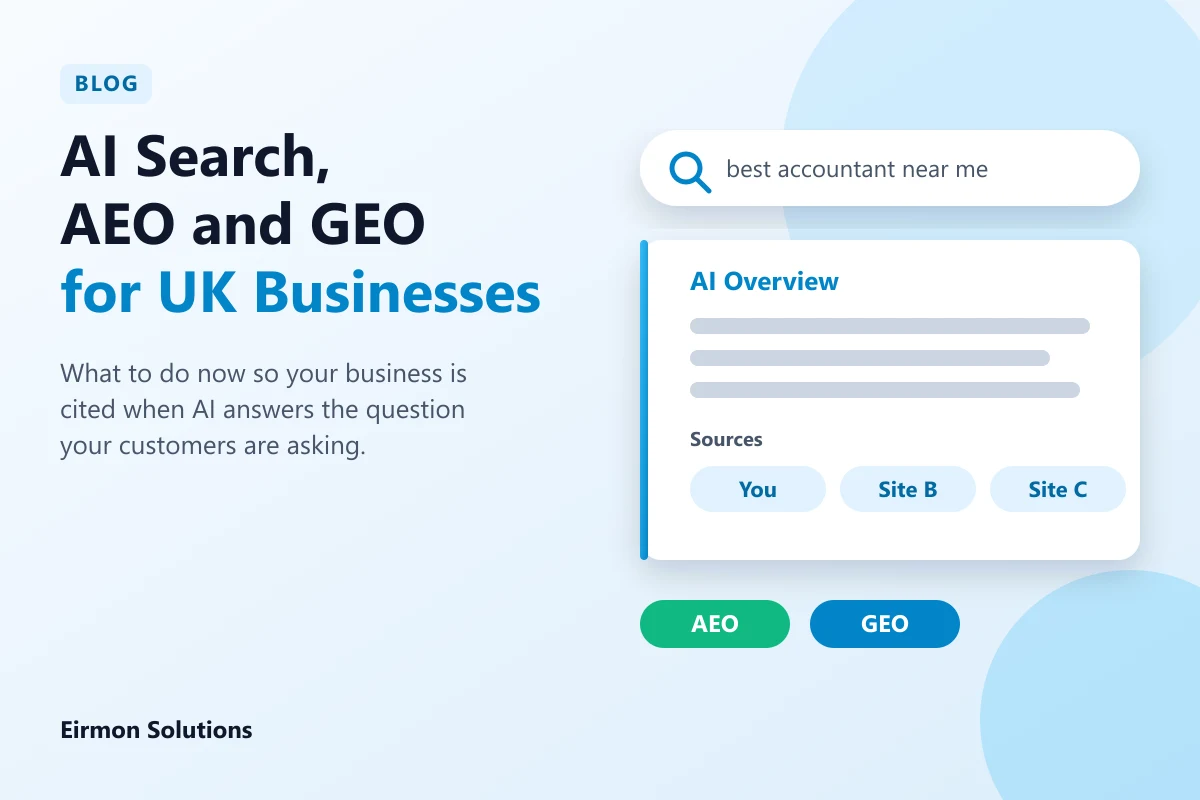
Google rolled out AI Overviews in the UK in August 2024. These are AI-generated summaries that appear above the traditional results for many questions, with links to the sources used.
In July 2025 Google launched AI Mode in the UK - a conversational, full-page search experience that runs several searches behind the scenes and brings the results together into one answer. Since then Google has continued to connect the two, with some AI Overviews expanding into longer, AI Mode-style answers.
Alongside Google, many people now ask ChatGPT, Microsoft Copilot, Perplexity and other assistants for recommendations and explanations. Together, these are often called AI search.
What are AEO and GEO?
- AEO (answer engine optimisation) means structuring content so a search engine or assistant can pull out a direct answer - the kind shown in featured snippets, voice answers and AI summaries.
- GEO (generative engine optimisation) means improving the chances that generative AI tools mention or cite your business and content when they build an answer.
They overlap heavily, and both depend on the same thing traditional SEO does: being the most useful, trustworthy source for a question.
Does AI search mean fewer website visits?
For some simple informational questions, yes - people get what they need from the summary and don't click. But questions that lead to a purchase or an enquiry usually still end with a visit, a call or a booking. Visitors who do click from AI answers often arrive better informed.
The practical response is to focus on questions where your business can help, and to measure enquiries rather than raw traffic.
How do you get cited in AI Overviews and AI answers?
Google's own guidance is that there are no special requirements to appear in AI features beyond normal SEO best practice: your page must be indexable and eligible to show a snippet. Beyond that, these habits make a real difference:
1. Answer the question directly, early
Put a clear, one- to three-sentence answer near the top of the page or section, then expand. That is why you'll see a short-answer box at the top of our articles.
2. Use question-based headings
Headings such as “How much does a website cost in the UK?” or “What is local SEO?” mirror how people ask questions - and make it easy for systems to match your content to a query.
3. Be specific and original
AI tools have seen every generic article. Content that includes your own experience, examples, UK-specific details, prices or processes gives them something worth citing. Google's guidance on helpful, people-first content is the best reference here.
4. Make your business a clear entity
Search engines build an understanding of businesses as entities - who you are, what you do, where you work. Help them with:
- Consistent name, contact details and descriptions across your website, Google Business Profile, LinkedIn and directories.
- Organisation and service schema markup on your site.
- An About page that explains who is behind the business.
5. Use structured data where it fits
Schema markup (Article, FAQ, Service, Organisation, Breadcrumb) doesn't guarantee inclusion, but it removes ambiguity about what your page contains.
6. Keep technical SEO healthy
AI features draw on the same index as normal search. If pages are slow, blocked, duplicated or hard to crawl, they won't be used. See our Core Web Vitals guide.
Should you block AI crawlers?
Some businesses block AI crawlers in robots.txt to protect their content. For most service businesses that want to be recommended, blocking is counter-productive. Note that Google's AI features use the normal Googlebot index; blocking Googlebot would remove you from search entirely.
How do you measure AI search visibility?
Measurement is still immature. Practical options today:
- Search your key questions in Google, AI Mode and major assistants each month and note whether you are cited.
- Watch Google Search Console for changes in impressions versus clicks on informational pages.
- Ask new enquiries how they found you - “ChatGPT recommended you” is increasingly common.
A simple AI search checklist
- List the 20 questions customers ask before buying from you.
- Make sure each has a clear, direct answer on your site.
- Add FAQ sections and relevant schema.
- Tidy up your Google Business Profile and directory listings.
- Publish something genuinely original each month - a guide, a price explainer, a lessons-learned post.
Our SEO service now includes AI search visibility as standard.
Sources and further reading
Written by
Eirmon Solutions Editorial TeamWeb, SEO and marketing team
Practical guides on web design, SEO, AI and digital marketing from the Eirmon Solutions team, written for UK business owners and checked against the sources listed with each article.